
H.E. Ion JINGA, Ambassador Extraordinary and Plenipotentiary, Permanent Representative Council of Europe.
Motto:“A great tradition can be inherited, but
greatness itself must be won.” – Sir Winston Churchill
In
a span of just 30 days, four major international events with the potential to
shape the world took place. The first was the World Economic Forum in Davos,
Switzerland, on 19-23 January 2026. The Davos Forum is uniquely
powerful because of its ability to gather the people who move the world in one
space. This year, its theme was “A Spirit of Dialogue”, and the
participation of the President of the United States, Donald J. Trump, created a
global visibility, with over 3,000 attendees – including more than 60 heads of
state and government, heads of nearly all major international organizations,
and more than 1,000 CEOs from around the world. In a time when
uncertainty has become the new normal,the Forum facilitated the making of history by creating the
conditions for key-actors to exchange on some of the most consequential
questions of our age.Davos
2026 probably foreshadowed global developments for the next decade (I wrote
about this in the article “When
the Tectonic Plates of Geopolitics Move”).
The
second moment I am referring to is the informal retreat of the European
Union leaders at Alden-Biesen Castle, Belgium, on 12 February 2026. The heads
of state or government of the EU countries usually meet formally in the
European Council format but, as debates on the EU’s future intensifies, the
President of the European Council, António Costa,
introduced informal “retreats” –
meetings designed to let leaders brainstorm without the pressure of reaching
conclusions. This year the focus was on how to deepen the single market, reduce economic dependencies and boost competitiveness. An important topic referred to the
energy transition, considered as the best long-term strategy for Europe to
achieve strategic autonomy. The “two‑speed
Europe” proposal (aiming to advance reforms by bypassing the unanimity vote),
and the so-called “European preference” (which would favor domestic companies in strategic sectors) were also tackled.
At the end of the
meeting, António Costa summed up the political message: “We have a clear priority: to strengthen economic growth in Europe.
This is essential for our prosperity, to create quality jobs, and to sustain
our economic social model. We hold a powerful card: our single market. With 450
million consumers, it is Europe’s true superpower and we must use it to the
fullest potential”. Participant in the retreat, the President of Romania, Nicușor Dan, remarked:
“There was an agreement of all the
participants, that we do not want a market that is protectionist in Europe.
Instead, in response to certain non-competitive practices, Europe needs to
respond very quickly to protect certain sectors of its economy… Europe with multiple speeds,
or at least as the idea stands at the moment, is simply a meeting in which
countries that have certain ideas coordinate in order to put together a
proposal on the European Council’s table. There should be no concern here”.
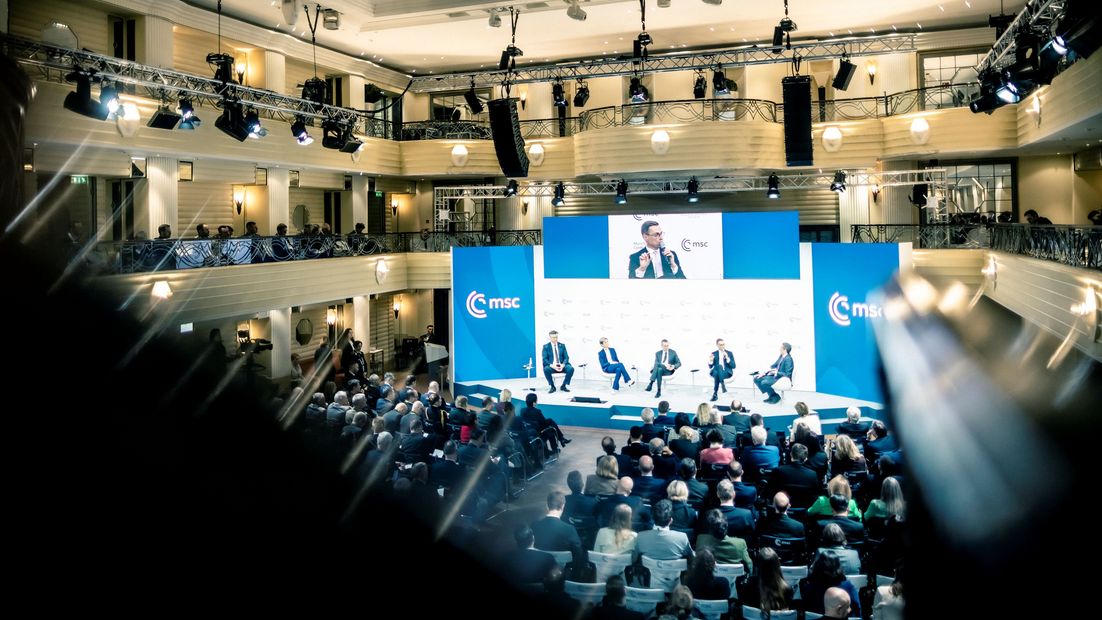
The third major event was the Munich Security Conference, on
14-16 February – the most important annual summit in the field of security and
defense, with more than 1,000 delegates – including 61 heads of
state and government, and 101 foreign and defense ministers.
As Ambasador Wolfgang Ischinger, the Chairman of the Conference and a legend of
German diplomacy, noted: “Rarely in the
conference’s recent history have there been so many fundamental questions on
the table at the same time: about Europe’s security, the resilience of the
transatlantic partnership, and the ability of the international community to
manage an increasingly complex and contested world”.
Traditionally,
before the conference starts, the Munich Security Report is published. This
year the report has the title “Under
Destruction”, and concludes: “Many people perceive their
political systems and international institutions as incapable of addressing
mounting global risks and of managing the challenges that come with economic
transformations and technological change… Decision-makers are widely seen as
guardians of the status quo, administering paralyzed political systems that
appear unresponsive to the majority of people. Key institutions of the
international order have come to be seen as rigid and unresponsive… Relying on sterile communiques,
predictable conferences and cautious diplomacy is a recipe for failure”.
A
similar perception is noticed with regard the trust in the rule of law. In an
interview for the Romanian newspaper Adevărul, on 8 February 2026, Judge
Matthias Guyomar, the President of the European Court of Human Rights – a fundamental
institution of the Council of Europe – pointed out: “All judges, the entire judicial system,
are currently facing a growing distrust or lack of trust from the people. And
we need to address this situation. I am talking about the erosion of people’s
adherence to the rule of law system. And this is really worrying. It is the
same everywhere, not only in Europe. There is a general concern about how to
convince people, how to offer an attractive and positive narrative to convince
them that the functioning of the courts is not against democracy, against popular
sovereignty. On the contrary, they function to support the daily life of
society. They work to defend the concrete rights of people. And by doing this,
the courts support democracy. Judges are part of the democratic system. These challenges
require innovation; they require more transparency. We must also be prepared to
communicate and explain our work. And in the end, our common ideals, peace and
justice, will prevail”.
On 13
February, the Chancellor of Germany, Friedrich
Merz,
wrote in Foreign Affairs magazine: “The return to power politics cannot be
explained solely by the rivalries among major powers. This new dynamic also
reflects the turmoil and unrest within societies where new technologies are
driving revolutionary change… We must realize that in this era of great-power
politics, our freedom is no longer a given. Preserving it will take
determination, and we must be ready for change, hard work, and even sacrifice…We must curb the proliferation of
European bureaucracy and regulation. Europe’s standards must not immobilize us
in global competition but should fuel innovation and entrepreneurship,
encourage investment, and reward creativity” (“How to Avert the
Tragedy of Great-Power Politics”). The Munich Security Conference
confirmed that Europe is accelerating strategic adaptation to reduce
vulnerabilities in an increasingly hectic environment. It also showed that the
transatlantic partnership remains strong. Before
leaving for Germany, the US Secretary of State Marco Rubio told reporters: “The old
world is gone and we are living in a new era in geopolitics, and that will
require all of us to reconsider what that looks like and what our role is going
to be”.Then, in Munich, he said: “We want Europe to be strong, as the two great wars of the last
century serve as historical lessons, a constant reminder that, ultimately, our
destiny is and will always be intertwined with yours”.
An event of
global impact took place on 19 February 2026 – the first meeting of the Board of Peace. An initiative of the
President of the United States and endorsed by the UN Security
Council resolution 2803 (2025), to implement the US-led 20-point Gaza Peace
Plan, the Board of Peace is a remarkable innovation in international
affairs. Representatives from around 50 countries and the European
Commission attended the inaugural meeting in Washington D.C., as members or observers. Addressing the
participants, President Donald Trump announced that a total of 17 billion
dollars has been pledged for relief and reconstruction in Gaza: “Every dollar spent is an investment in
stability and hope. Together we can achieve the dream of bringing
lasting harmony to a region tortured by centuries of war. With the commitments
announced today, the Board of Peace is proving that it does not just convene
countries, it devises and implements and real solutions happen… And we’re very closely working
with the United Nations”.The World Bank
will manage the donations and disburse them under the Board of Peace direction.
Several countries made pledges to send troops for a
Gaza stabilization force, while others committed to train police – the newly
created international stabilization force is expected to have 12,000 police and
20,000 soldiers.
At the Board of Peace meeting,
President Nicușor Dan reaffirmed Romania’s support to the peace process in Gaza:“I spoke today in Washington at the inaugural Board of Peace meeting
chaired by the US President Donald Trump. Without peace and security, there can
be no prosperity for our citizens. In this regard, Romania supports the efforts
of the US and the international community to resolve global conflicts,
including in the Middle East, and our presence as an observer in the Board of
Peace allows us to be part of the talks and negotiations… I remain a strong
supporter of transatlantic cooperation between the United States and the
European Union based on a constant and open dialogue. This balanced approach is
the one that brings the most benefits to our country, for which freedom,
democracy and the rule of law remain the fundamental coordinates”.
From Physics and Philosophy, we know that the Law of
Cause-and-Effect is one of the fundamental principles governing
our understanding of the universe – nothing
ever happens without a cause or without a succession of causes, and
for every action, there is a reaction. This
principle applies at all levels – nations, governments, societies,
corporations, institutions, or individuals. Politics is intrinsically
tied to the causes of change in society, as it involves forces, events, and
ideologies that influence how power is distributed, and how societies function.
The four major moments evoked in this article are political events having in
common the search for solutions to fundamental challenges our world faces. If
problems are common, then solutions must be common. And if both problems and
solutions are common, then their causes are intertwined. Historically, structural changes like
those we are seeing now only come around once in a century and may be
disruptive. But disruptions are not always destructive. When exceptional
situations require exceptional measures, they can be a catalyst for new construction.
Post Scriptum: I took inspiration for the title of this
article from the memoir “Times to
Remember” by Rose
Fitzgerald Kennedy, the mother
of President John F. Kennedy, because today just like in her time history is
being written before our eyes, and we are living times to remember. As the former UN Secretary General Dag
Hammarskjold – whom President Kennedy called “the greatest statesman of our century” – once said: “Do not look back. And do not dream about
the future, either. It will neither give you back the past, nor satisfy your
other dreams. Your duty, your reward – your destiny – are here and now”.